The
PICO Framework

An Operating System for B2B and B2C Lead Generation Brands

THE

PICO

FRAMEWORK

Our core philosophy

Digital marketing is no longer a creative exercise; it is an algorithmic arms race. Most organizations run campaigns based on intuition. This guide introduces the PICO Framework—adapted from the rigorous standards of medical research—to help you replace gut feelings with evidence-based marketing decisions.

Having navigated the industry’s evolution—from the garage days of early search to today’s complex AI-driven models—we have turned years of hard-won lessons into this framework. We understand the underlying physics of how these platforms work: if you feed the machine bad data, it will get very efficient at losing your money.

Disclaimer: This is not an exhaustive list of every tactical lever. It is a navigational framework designed to steer you in the right direction across Paid Search, Organic Social, SEO, Content Writing, Audiences, Tracking, and AI Search (AEO).

The One Question Your Strategy Must Answer:

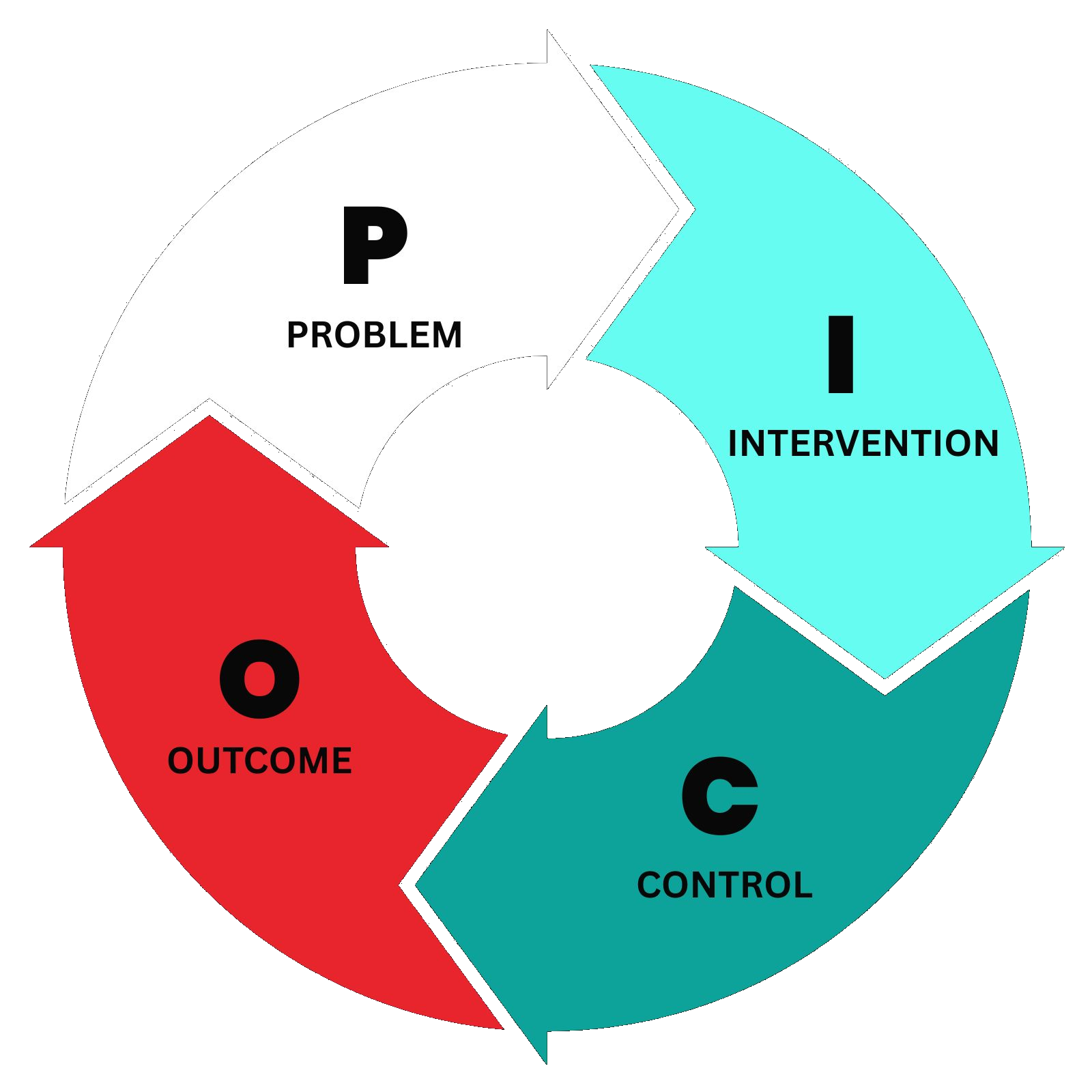
"In an audience segment suffering from low lead quality (Problem), how effective is a specific strategic shift (Intervention) compared to the historical baseline (Comparison) in improving the ultimate conversion from Lead to Sale (Outcome) over a 90-day sprint?"

P - PROBLEM IDENTIFICATION

Stop treating the symptoms. Find the root cause.

Before moving a single lever, you must find the leak. Use these diagnostic prompts to begin auditing your friction points; while not an exhaustive list, they represent the most common culprits:

Tracking & Data Poisoning: Is your tracking capturing conversions that aren't actually sales (e.g., bot spam, firing at the wrong time, or duplicate fires)? If the sensors are broken, the algorithm is learning the wrong patterns and optimizing for junk.

The ICP & Audience Reality Check: Does your current data represent your Ideal Customer Profile (ICP), or have you just gotten really good at attracting digital window shoppers who will never buy?

Paid Search Budget Bleed: Are you paying for informational keywords (e.g., definitions) when your ICP is actually using transactional queries (intent to buy)? Are you hunting the expensive clicks that never convert?

The SEO/AEO Trust Deficit: Are you invisible in search results because your content lacks the authority signals and structure required for modern AI Search Engines?

The Organic Social Ghost Town: Is your social presence a vanity project of automated posts that fail to trigger meaningful engagement or community trust?

The Post-Click Paradox: Is your landing page experience so disconnected from your ad copy that you are sabotaging your own traffic?

The Attribution Myth: Are you over-crediting one channel while ignoring the invisible assist from others that actually warmed up the lead?

I - STRATEGIC INTERVENTION

If you aren’t commanding the algorithm, it’s exploiting you.

The machine will eat your budget alive if you "just try stuff." Orchestrate evidence based moves to signal the algorithms exactly what you want.

Signal Integrity Realignment: Fix your tracking pixels and CRM conversions to ensure the algorithm is training on high-value Lead-to-Sale events, not just "Thank You" page visits.

The AEO/SEO Pivot: Build the Schema Markup and specialized FAQ structures that allow AI Answer Engines (LLMs and AI Search tools) to recommend your brand by name.

The Trust-First Content Pivot: Strip away robotic fluff. Build high-authority Content Clusters that prioritize user intent, proving to Google and your customers alike that your expertise is both deep and actionable.

The Data Feedback Loop: Take high-converting Paid Search terms and turn them into SEO-optimized Content pillars.

Paid & Social Structural Realignment: Re-engineer your architecture to speak to specific silos within your ICP. Stop the 'post-and-pray' method. Structure for isolation so you can identify exactly what’s driving performance, rather than burying insights under too many overlapping variables.

Community Activation Strategy: Re-engineer social content to trigger the specific engagement signals the algorithms require to put your brand in front of new, high-intent customers.

C - COMPARISON AND CONTROL

Benchmark against reality, not intuition.

A great idea is worthless if it doesn't move the needle. You must apply scientific rigor to ensure your growth is real, not accidental.

Data Reconciliation: Do not blindly trust platform dashboards. Reconcile platform data against your CRM. If the platform shows +20% but your bank account shows 0%, identify the cause of the discrepancy in the data before scaling.

The 90-Day Benchmark: Pit every new intervention against a historical baseline to find cold, hard proof of lift. To ensure this isn't just a "lucky month," maintain Statistical Significance by analyzing trends across hours, days, and seasonal cycles—ruling out anomalies until you have a clear, repeatable winner.

Follow-the-Sun Oversight: 90-day sprints require constant monitoring, not a set-and-forget mentality. Ensure your accounts are audited by a veteran eye 24/7—Pico leverages global teams (USA, UK, SA) to pivot in hours, not weeks.

The Cannibalization Check: Is your Paid Search bidding on keywords you already rank #1 for organically? Are you paying a tax for traffic you already own? Is this necessary because competitors are bidding on your brand terms?

O - OPTIMIZED OUTCOMES

Certainty is the most valuable asset in business.

The outcome isn't a PDF report; it is Business Intelligence that fuels the next phase of your growth.

Radical Transparency: Be brutally honest about what worked, what stalled, and exactly why. A failed hypothesis is still a win if it saves you from a full-scale rollout disaster.

The Sales Translation: Take the winning hooks and pain points you've identified in your marketing and hardwire them into your sales scripts, email sequences, and product launches.

The Negative Learning: Use your data to prove which ICP sub-segments or hooks do not work. Ruling out losing paths buys you certainty.

Human Centricity: We interpret the intent behind the interaction to confirm alignment. We distinguish between Relational Drivers, where success is measured by community engagement, and Transactional Drivers, where informational speed and search precision are optimized to meet the defined campaign KPI.

The Infinite Loop: Every Outcome becomes the Problem for your next 90-day cycle, creating a compounding interest effect on your growth.

Real-Life Focus Group

Don't just collect clicks; collect consumer truths. Treat every test like a focus group that informs your entire business.

PICO IN PRACTICE

How Data Integrity saves your ROI from Algorithmic Drift.

During week one, we identified a critical failure: the Google Ads algorithm was training in the dark. It was triggering conversions on page loads rather than completed transactions, causing the machine to optimize for false signals and ghost conversions. We executed an immediate reset to prevent further budget bleed.

  • P — Problem: Tracking was fundamentally broken, leading Google to over-report purchases. The algorithm was effectively learning how to waste the budget more efficiently.
  • I — Intervention: We performed a technical realignment to engineer a clean conversion signal triggered only by verified, unique purchases.
  • C — Comparison & Control: We built a cross-channel reconciliation matrix—pitting Google Ads against Analytics and CRM data—to establish a 100% accurate historical baseline.
  • O — Outcome: By feeding the algorithm clean data, we transitioned the campaign from guesswork to active engineering, allowing the machine to finally recognize and target profitable patterns.

Lumana Achieves 15% Growth in SQL Accepts Within Two Months

We deployed the PICO Framework for Lumana to bridge the gap between adspend and sales. By integrating HubSpot conversion data directly into the ad algorithms, we shifted the engine’s learning from surface-level clicks to high value outcomes. This alignment enabled the precise refinement of messaging and structure to drive Lumana’s data-backed growth engine.

THE SILENT KILLERS

6 Questions to ask your marketing team

  1. The Customer Tax: “How much of our prospecting budget is being wasted on people who already pay us?” When exactly was the last time we updated our Negative Audience lists to exclude current customers?
  2. The Creative Variable Test: “Beyond ‘new images,’ what specific variables are we testing right now?” Are we testing Format (Carousel vs. Video), Style (UGC vs. Studio), or Hook? High-growth brands don't just "post ads"; they aggressively test what stops the scroll while maintaining brand integrity.
  3. The ICP Drift: “Are we targeting whom we think wants us, or who is actually paying us today?” When was the last time we audited our targeting against actual Closed-Won sales data? Markets shift, and audiences evolve. If your targeting parameters haven't adjusted to match your most recent high-value conversions, your reach is drifting away from reality.
  4. The "Immediate" Paid Flywheel: “How is our Paid data actively informing our other channels right now?” Which high-performing ad hooks and headlines are we feeding back into our website, SEO, and email copy? Paid media is the fastest testing environment you have.
  5. The "Last Mile" Conversion Friction: “What happens after the click?” What is the specific drop-off rate on our destination pages across all devices? When was the last time we changed a technical element on the landing page (speed, form length, or mobile UX) rather than just swapping the ad creative? A great ad cannot fix a broken destination.
  6. The Institutional Amnesia: “Are we paying to learn the same lessons twice?” Where is the Win/Loss log of every experiment we’ve run in the last six months? If the "why" behind a failed campaign or a winning creative isn't documented and accessible, your marketing department has no memory.

THE STRESS TEST

Is your strategy dying or thriving?

Rate your current operations on a scale of 1–5 (5 being Excellent).

Data Integrity
Can we prove our tracking is 95%+ accurate and that we are passing the correct conversion data to the algorithm? [ ]
Data Ownership
Do we retain 100% ownership of all accounts and data if the contract is canceled? [ ]
Veteran Execution
Is the person developing and executing the strategy a specialist with 7+ years of experience? [ ]
The Lab Rigor
Can we prove a 90-day Control vs. Intervention test and a transparent framework for sharing results? [ ]
Creative Testing
Beyond "new images," are we testing specific Hooks, Styles (UGC vs. Studio), and Formats (Carousel vs. Video)? [ ]
Incentive Alignment
Is our agency fee a flat rate (aligned with profit) or a commission on spend (incentivized to waste budget)? [ ]

Total Score: * 20-30: You are a PICO-level operator. Below 20: Your marketing is an expense, not an engineered asset.

THE BOUTIQUE ADVANTAGE

Senior-Led Execution

Applying the PICO Framework requires precision, patience, and decades of pattern recognition. We stay boutique by choice for one reason: Personal Accountability. Our founder has been in the digital marketing trenches since the industry's garage days. Unlike giant agencies that hand you off to a junior the moment the ink is dry, our founder remains personally involved with every client and every strategy. We treat your budget with the same respect we treat our own—focused entirely on results, not on how much of your money we can spend.

If you are tired of wasting spend and want a veteran team to engineer this continuous growth loop for your business, let’s talk.